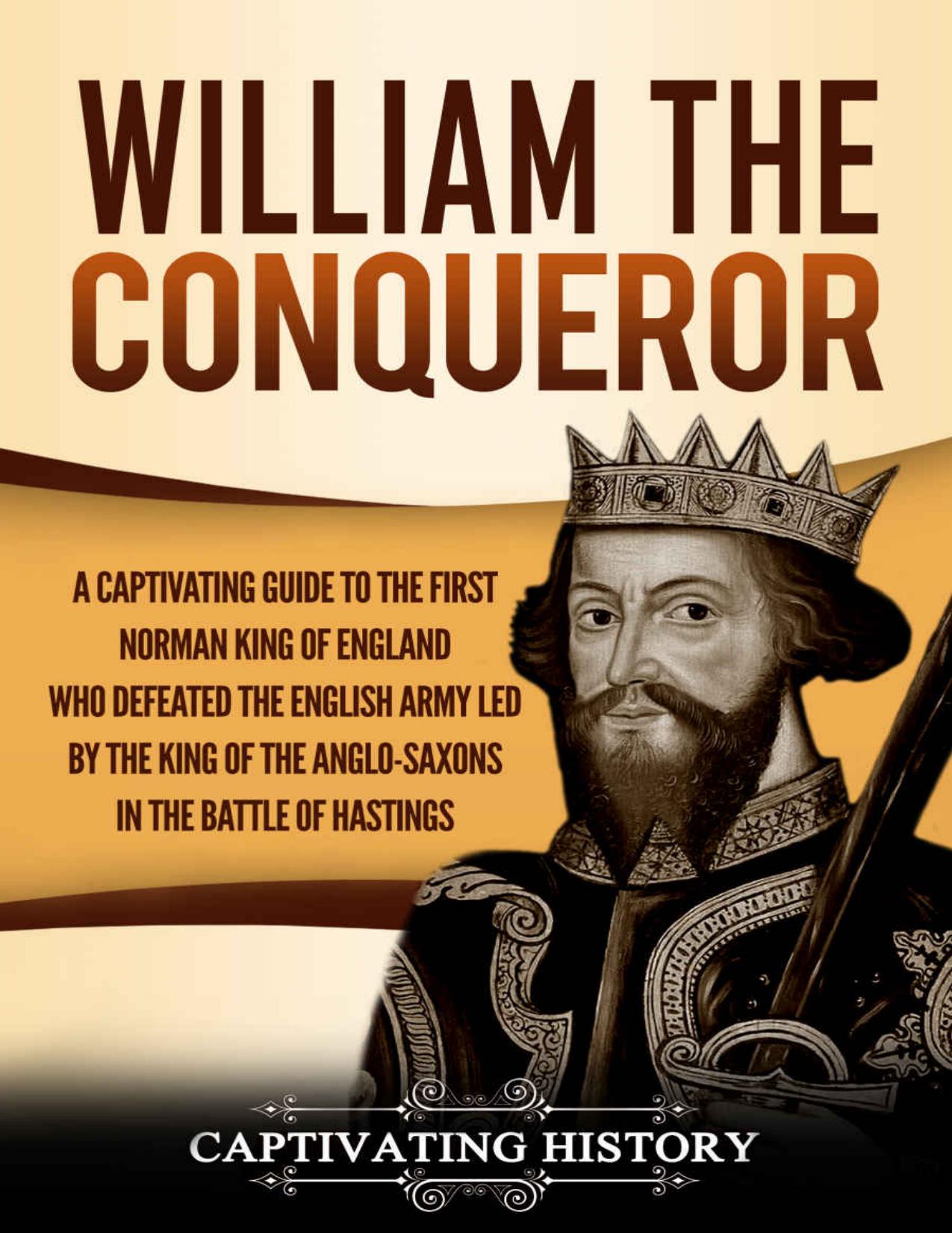
William the Conqueror: A Captivating Guide to the First Norman King of England Who Defeated the English Army Led by the King of the Anglo-Saxons in the Battle of Hastings by Captivating History
Author:Captivating History [History, Captivating]
Language: eng
Format: azw3, pdf
Published: 2020-12-13T16:00:00+00:00
An authentic sealed writ of Edward the Confessor, issued in favor of Westminster Abbey[vi]
Prelude to the Conquest: Events in Normandy between 1057 and 1066
Written sources donât offer too many concrete details on Williamâs activities between 1057 and 1060, though there are a few key details we can piece together based on what we do know. In early 1058, William had started invading the territory of the County of Dreux, taking over two important fortresses: Tillières and Thimert. Medieval writers such as Orderic Vitalis claim that there was a meeting at Fécamp that involved the duke, Bishop Lesceline of Paris, and Bishop Fulk of Amiens. The two bishops were on a peace mission from King Henry I, and supposedly, as an act of goodwill and an effort to maintain peace, the French king had gifted Duke William Tillières, which had been in his possession since the early 1040s. However, with Williamâs takeover of Thimert, King Henry was convinced that he needed to take action, so he besieged the castle. Ralph IV, Count of Valois, provided help to Henry in 1058, as did Count Theobald III of Blois a year later, who was less than thrilled to do it and even less cooperative on the battlefield. Williamâs forces managed to hold the line for the next two years, with William himself traveling around the country and performing other ducal duties.
Interestingly, the year 1060 would prove to be the best possible year for Williamâs military exploits. William besieged a few more castles, namely Saint-Céneri-le-Gérei and La Roche-Mabile, both under Robert Fitz Giroie. Robert would die on February 6th, 1060, allowing his nephew, Arnold dâEchauffour, to succeed him in other matters. It should be noted that William was handling this siege at the same time King Henry was going after Thimert, showing that the duke was confident in waging war on two separate fronts.
Of course, 1060 was a year that just kept on giving. After a siege that looked more and more like a stalemate, King Henry I of France died on August 4th. The man who had proven to be both one of Williamâs supporters and one of his most bitter enemies was no more; the siege of Thimert would be the last interaction the two men shared. And then November 14th rolled around, and the other bitter enemy of William who had been an ally of Henry, Count Geoffrey Martel of Anjou, passed away as well. Henryâs successor, Philip I, was only eight years at that point, and two individuals would take it upon themselves to act as his regents. One was his mother, Queen Anne of Kiev, who had actually named the boy (Greek names like âPhilipâ were uncommon among western European leaders). In fact, she would become the first queen in the history of France to act as a regent, as well as the first Russian queen to have any semblance of power in France.
However, the other individual who became a regent for young Philip was far more important for both William and Normandy in general.
Download
William the Conqueror: A Captivating Guide to the First Norman King of England Who Defeated the English Army Led by the King of the Anglo-Saxons in the Battle of Hastings by Captivating History.pdf
This site does not store any files on its server. We only index and link to content provided by other sites. Please contact the content providers to delete copyright contents if any and email us, we'll remove relevant links or contents immediately.
The Art of Coaching Workbook by Elena Aguilar(51388)
Trainspotting by Irvine Welsh(22004)
The Secret History by Donna Tartt(19479)
Twilight of the Idols With the Antichrist and Ecce Homo by Friedrich Nietzsche(18784)
All the Missing Girls by Megan Miranda(16742)
Cat's cradle by Kurt Vonnegut(15566)
Ready Player One by Cline Ernest(15155)
Talking to Strangers by Malcolm Gladwell(13561)
Fangirl by Rainbow Rowell(9481)
The remains of the day by Kazuo Ishiguro(9228)
The Compound Effect by Darren Hardy(9169)
Thirteen Reasons Why by Jay Asher(9134)
Tools of Titans by Timothy Ferriss(8603)
Periodization Training for Sports by Tudor Bompa(8425)
Wonder by R. J. Palacio(8257)
A Court of Wings and Ruin by Sarah J. Maas(8120)
The Lover by Duras Marguerite(8059)
Change Your Questions, Change Your Life by Marilee Adams(7938)
Giovanni's Room by James Baldwin(7572)
